WiRSA (Wisconsin Rural Schools Alliance) - Strong Schools - Strong Communities

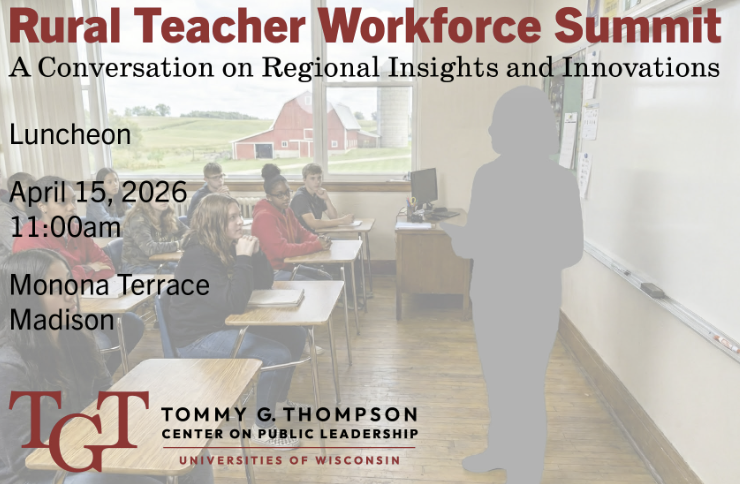
Wisconsin’s continued prosperity is intertwined with the sustainability and success of its rural communities and schools. Investing in innovative approaches to strengthening the rural educator workforce is imperative for students imagining future careers and families seeking economic opportunity. Rural schools, together with strong university partners and supportive policymakers, can shift the narrative on teaching as a profession and encourage the next generation of teachers to make a difference in rural communities across the state.
Join us for an engaging discussion with panelists from Wisconsin, Minnesota, and Illinois to learn more about effective and exciting solutions to the rural teacher shortage!
A Rural Teacher Workforce Summit on April 15 is made possible by the generous support of the Tommy Thompson Center for Public Leadership at UW-Madison. The Summit will include an overview of our first and second papers in this series as well as two specific policy areas impacting the rural educator workforce: opportunities for paid student-teaching positions in rural districts and “grow your own” educator programs. Our panel includes two current Wisconsin rural superintendents, an education policy expert from the Wisconsin Policy Forum, and education researchers from Minnesota and Illinois who will provide a regional perspective on how similar challenges are being addressed in their respective states.
This event will be held at Monona Terrace in Madison from 11am-2pm and will be recorded. The registration includes an in-person option (with lunch!) as well as a livestream option. You can register for the event here.
We encourage you to both register and circulate to colleagues within your networks who have an interest in challenges and innovative practices impacting the rural educator workforce.
Grants to Secondary Schools Aimed at
Strengthening Rural Healthcare
This spring, rural school districts will have an opportunity to apply for grants of up to $41,000 annually to develop new or expand career pathways in healthcare and human services. A pool of $5 million over five years is being made available by the DPI from the Wisconsin Department of Health Services’ Rural Health Transformation Program, an initiative by the U.S. Centers for Medicare & Medicaid Services (CMS) to strengthen and modernize healthcare in rural communities across the United States.
What can schools do with this funding?
Launch new or expand existing healthcare and human services Career and Technical Education courses
Create or expand dual-credit opportunities
Develop or enhance work-based learning experiences in healthcare and human services settings
Help students earn industry-recognized credentials aligned with rural workforce needs
Establish or strengthen a local HOSA-Future Health Professionals chapter to engage students in leadership, community health initiatives, and competitive skill events
A minimum of twenty rural secondary schools will be selected to participate in this program. Selected schools must be committed to receiving funds for up to five years to build a sustainable program, ensuring lasting impact in their communities. The goal is clear: build a stronger, more resilient rural healthcare workforce pipeline by connecting students to education, training, and employment opportunities right in their communities.
What's next?
More details, eligibility information, and application guidance are coming soon. Grant information and updates will be shared at: https://dpi.wi.gov/cte/rhtp-grant.
Questions? Contact christina.patrin@dpi.wi.gov
The governor signed two bills on March 13th.
SENATE FLOOR CALENDAR, 11:00 AM, TUE, MAR 17
Senate Bills with Assembly Amendments
EDUCATION RELATED
AB-098 - Tribal Regalia (Special Committee on State-Tribal Relations) Pupils wearing traditional tribal regalia at a graduation ceremony or school-sponsored event.
AB-460 - Parental Choice (Duchow, Cindi) Pupil eligibility for parental choice programs based upon participation by a sibling or a dependent child of the pupil's parent or guardian.
AB-530 - Drone Operation (Kitchens, Joel) The operation of drones over school property and providing a penalty.
AB-582 - Dual Enrollment (Murphy, Dave) Dual enrollment programs, creating the Council on Dual Enrollment, and transfer of postsecondary course credits.
SB-699 - Pupil Transport (LeMahieu, Devin) Alternative methods of providing pupil transportation services.
SB-785 - DPI Licensing Portal (Jagler, John) Including information about investigations of license holders in an online licensing portal maintained by the Department of Public Instruction.
AB-918 - Human Development Instruction (Summerfield, Rob) Required subjects in a human growth and development instructional program.
AB-998 - Early Literacy (Wittke, Robert) Recommendations made by the council on early literacy curricula.
AB-1004 - Confidentiality Agreements (Nedweski, Amanda) Prohibiting education employers from entering into certain agreements related to information about alleged immoral conduct by an employee and civil immunity for information provided to a prospective employer.
ADDITIONAL Higher Education
AB-750 - Technical College Admission (Dittrich, Barbara) Admission of students to technical college programs.
AB-1005 - Undergraduate Admission at UW System (Gustafson, Nate) Admission to University of Wisconsin System institutions.
AB-1034 - UW Name Rights (Dallman, Alex) Name, image, and likeness rights for University of Wisconsin System student athletes; maintenance costs for University of Wisconsin–Madison intercollegiate athletic facilities; and making an appropriation.


Link to register for April 15 Graduation Planning: Virtual Presentation on Non-Classroom Events
Course Description: OSS is hosting a virtual presentation on planning for non-classroom events with a focus on upcoming graduations. SS 118.07 requires each school safety plan to include a non-classroom event protocol. Information will be shared on assessment of events and venues, creating Incident Action Plans and best practices related to hosting safe and secure non-classroom events. A link to join will be emailed the day before the event.
ICAC will be providing a free virtual training that OSS is hosting. Sign up for the April 30th training- and share this with others.
Summary - Protecting Students from Online Sextortion - Virtual 4-30-2026
April 30 Sextortion Event Flyer: April 30 Sextortion Event Flyer
Link to Sextortion Press release with Public Service Announcement video 12.18.25-Sextortion-PSA-Launch.pdf
Protecting Kids Online (PKO) Podcast episode on Sextortion (featuring Jesse Crowe, ICAC Commander for the ICAC Wisconsin Task Force): Recognizing Sextortion (Feb 2026): https://www.buzzsprout.com/63684/episode_players/18676716-recognizing-sextortion?t=0
Representatives from NREA, our state affiliates, and our partner organizations are headed to Washington, D.C. to advocate for rural issues. Join us in raising your voice on behalf of rural communities on March 24!
Just 2 Weeks Left to Submit Your Proposal
2026 National Forum to Advance Rural Education
October 19-21, 2026 | San Antonio, Texas
Time is running out to submit a proposal for the 2026 National Forum to Advance Rural Education—the nation’s premier conference focused on advancing opportunity and innovation in rural schools and communities.
Hosted by the National Rural Education Association (NREA) in partnership with the Texas Rural Education Association, the Forum brings together rural educators, school and district leaders, higher education faculty, researchers, policymakers, and community partners from across the country.
What’s New for 2026: Rural Innovation & Impact Showcase Competition
This new national competition will spotlight proven, rural-centered innovations with measurable impact. Finalists will present their work live at the Forum, with the winning initiative receiving a $5,000 award.
3 Ways to Present
45-Minute Learning Sessions: Interactive, practitioner-focused sessions that showcase innovative or promising practices aligned with this year’s conference strands.
45-Minute Research Sessions: Blinded, peer-reviewed research presentations highlighting applied and emerging rural education research. Top-scoring proposals compete for the prestigious Howard A. Dawson Best Research Paper Award.
NEW! Rural Innovation & Impact Showcase Competition: (Separate submission required).
Bring your ideas. Share your impact.
Join us in San Antonio for #RuralEdForum 2026.
Proposals Due: March 27, 2026
Policy Intelligence and Education News
II. Policy Intelligence and Education News
GAO investigation of interagency agreements – GAO will investigate ED’s interagency agreements to transfer management of more than 40% of its program funding to the Department of Labor in response to a request from a number of Democratic senators involved in education funding and authorization for an investigation into what they called “Trump’s Efforts to Dismantle Education Department.” The request came from Senators Elizabeth Warren (D-MA), HELP Committee ranking member Bernie Sanders (I-VT), Appropriations Committee vice chair Patty Murray (D-WA), and Labor-HHS-Education Subcommittee ranking member Tammy Baldwin (D-WI). Senator Warren’s press release today has a very detailed list of many Democratic requests for information and transparency about ED actions, and requests to stop taking steps to shut down functions of ED.
WiRSA Conference 2026
”Celebrating Innovation and Resilience”
WiRSA Conference Room Reservations - OPEN NOW!
Rate: $101.00 Single Occupancy State Rate - $124.00 Double Occupancy State Rate
Guests can book their reservations online 24 hours a day by using the following link: Holiday Inn Express: WiRSA Conference 2026
Making reservations over the phone, please call 715-344-0200 and press #1. When making reservations, please reference the group name, WiRSA Conference 2026, or the Group Block Code: WIR.
Group rate will be available until 09/28/2026 (or until the block is full). Remaining rooms in your will be released for general reservations at the hotel's prevailing daily rate, which may be higher than your group rate.
BOOK YOUR ROOM TODAY!
WiRSA Conference Registration- OPEN NOW!
Thursday, October 29 & Friday, October 30, 2026
Welcome Reception
Wednesday, October 28, 2026 - 6:00 p.m.
Stevens Point Convention Center - Stevens Point, WI
A conference for administrators, board members, teachers, CESA employees, higher education professionals, public library administrators, elected officials, and citizens passionate about rural school and community issues.
WiRSA Conference - CALL FOR PROPOSALS
“Celebrating Innovation & Resilience” focuses on how rural schools thrive by responding to challenges and limitations with creative solutions. Breakout sessions will align with one of the following tracks:
Resource Management & Collaboration: Strategies for utilizing limited resources; managing budgets; addressing declining enrollment; and responding to community needs, such as school-sponsored child care or health care/mental health partnerships.
Technology & Future Readiness: Focusing on emerging technologies, preparing students for a workforce shaped by AI, and leveraging AI tools for school leaders.
Educational Pathways & Programs: Highlighting innovative educational programs and effective classroom practices, including Academic and Career Planning (ACP), high school pathways, dual credit options, and the development of partnerships with higher education and businesses.
Proposals are due by Friday, June 26, 2026